
Right from the beginning of our existence (as Nest Insight, now the Centre for Inclusive Money at Nest), learning from other systems has been an important part of our approach. Our focus is low- and moderate-income households in the UK, but we want to ensure that we’re both leaning on international experience and best practice, and sharing what we learn to inform systems-level change around the world. Looking at how comparable financial security challenges are being addressed elsewhere can help us develop better solutions here at home, while sharing what we’ve learned can also contribute to progress beyond the UK too. This commitment to learning from other countries and sectors remains an important part of how we work.
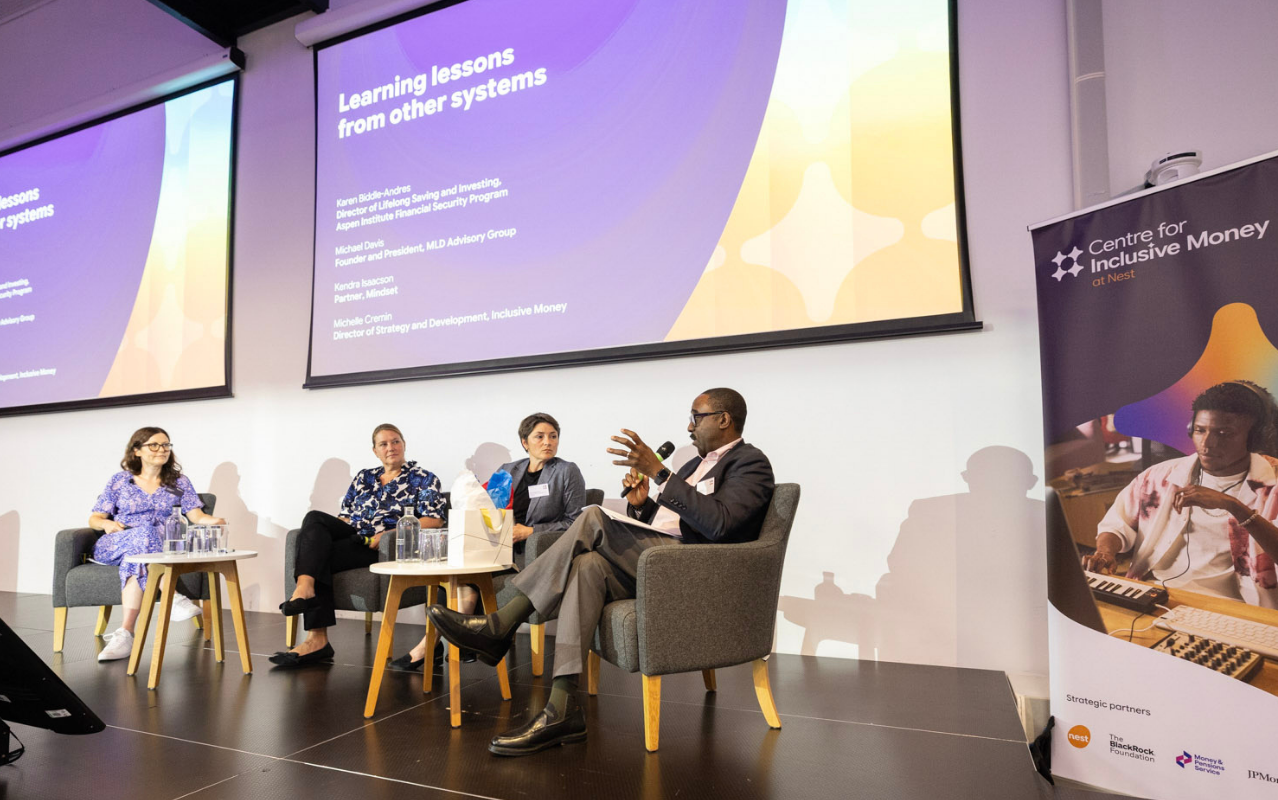
That theme was the focus of the final panel discussion at our recent conference, where I was joined by Karen Biddle Andres, Kendra Isaacson and Michael Davis to talk about what the UK and US can learn from one another.
One example of that exchange in action is emergency savings, where learning has flowed in both directions between the UK and US.
In the UK, a quarter of adults have less than £100 in savings and almost two thirds (65%) would not be able to get through three months without borrowing if they lost their income. People in the US faces similar challenges, and there are concerns about the longer-term implications of people accessing retirement savings early to meet short-term financial needs.
Since 2018, Inclusive Money has been exploring how payroll saving can help people build emergency savings. Through a series of real-world trials, we’ve built evidence showing that workplace savings schemes, particularly those using opt-out approaches, can be a powerful and inclusive way to support saving among people who may previously have struggled to build a financial buffer.
During our conference discussion, panellists reflected on how the exchange of ideas and evidence across the Atlantic has helped to shape innovation and systems change. In the US, learning from our UK workplace savings trials has helped to inform the development of emergency savings provisions within the SECURE 2.0 Act: legislation that enables retirement plans to play a greater role in supporting workers’ short-term savings needs alongside long-term retirement saving. As a result of that legislation, some US providers are now offering pension-linked emergency savings accounts.
Here in the UK, we’re keen to learn how those provisions are playing out, and our panel was able to share some key insights.
Watch the panel discussion
Emergency savings and retirement savings are supportive of each other
One of the strongest themes from the discussion was the growing recognition that emergency savings and retirement savings can support each other rather than compete.
In both the US and UK, there’s been some concern that encouraging people to build emergency savings might come at the expense of retirement saving. But we heard from the panel that what they’re seeing in the US is that strengthening short-term financial resilience is supportive of longer-term saving. Kendra Isaacson highlighted early findings from pension-linked emergency savings accounts showing a 13% increase in retirement saving among participants, while Michael Davis pointed to a BlackRock Emergency Savings Initiative report suggesting people with emergency savings are more likely to contribute to retirement plans. Together, these findings reinforce an increasingly proven idea: helping people build a financial buffer today can help them stay on track for retirement too.
Progress happens when policy, industry and evidence come together
Another theme was the importance of different parts of the system working together. The development of pension-linked emergency savings in the US did not happen because of a single organisation or policy intervention. It emerged through collaboration and dialogue between researchers, advocates, policymakers, employers and providers.
The panel offered a useful reminder that systems change is rarely linear. Ideas need to be tested, evidence built, policies developed and solutions implemented in practice. The journey from early thinking on emergency savings to the SECURE 2.0 ACT and adoption in the US illustrates how progress can be accelerated when different actors work towards a shared goal.
Looking at financial security as a whole
While much of the conversation focused on emergency savings, the discussion ultimately returned to a broader point: retirement outcomes cannot be considered in isolation. For people managing day-to-day financial pressures, retirement is only one part of a much bigger picture. Building a more joined-up system means recognising those connections and designing solutions that work with the realities of people’s lives.
Make sure you watch the video to hear the full conversation, which also touched on topics ranging from investing and early wealth-building to technology, retirement coverage and the particular challenges facing self-employed people.
You might also be interested to read our:
From the US:
Michelle Cremin – Director of Strategy and Development
If you’re interested in this work, or would like to find out more, we’d love to hear from you: hello@inclusivemoney.org.uk