
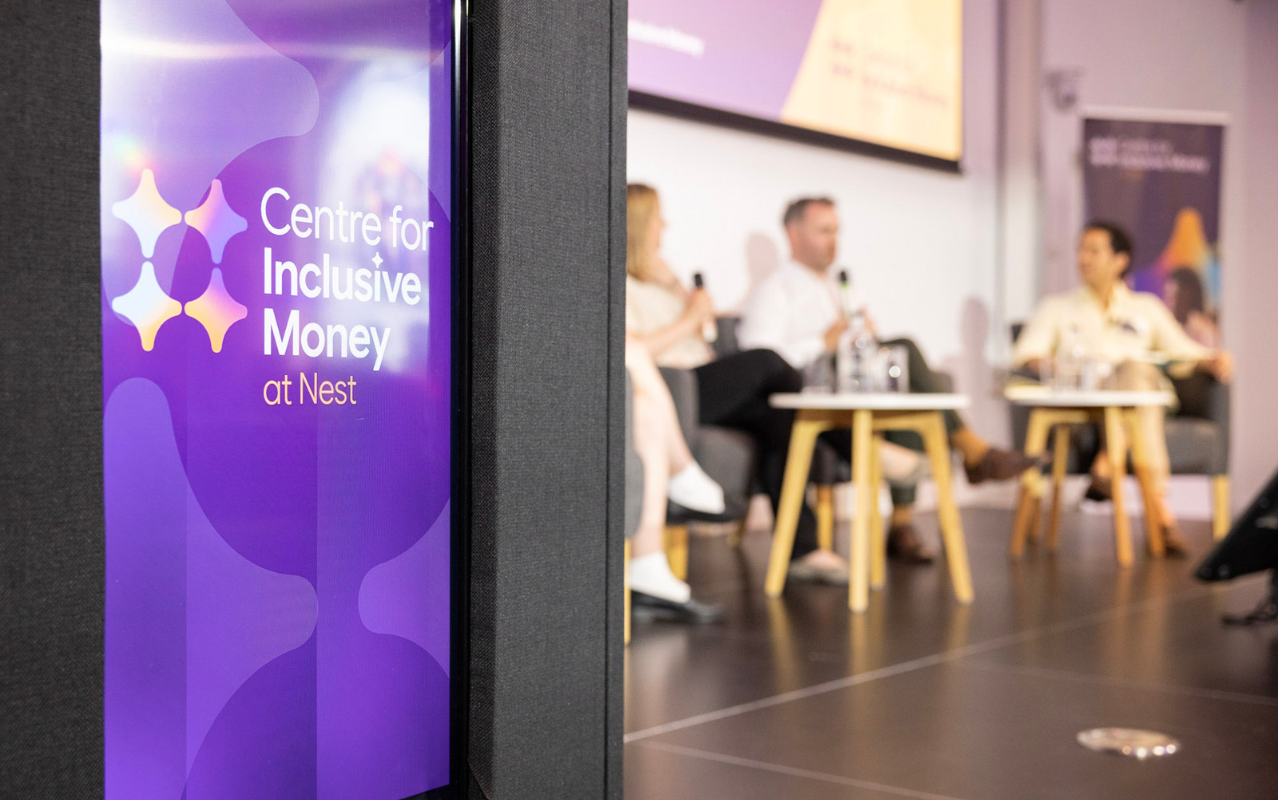
At this year’s annual conference – our first as the Centre for Inclusive Money at Nest – we explored a question that sits at the heart of financial security: what comes after building an emergency savings buffer?
Much of the conversation, and our work to date, has focused on helping people manage the pressures for today while saving for retirement. Both are essential, but a lot of life happens in between. People might want to buy a home, support their families, start a business, build financial independence, or simply feel more confident about the future. Financial security is not just about coping. It is also about making progress.
To explore this challenge, we set out on a new ‘Investing and Growing’ area of work to identify, co-create and test ideas to ensure low- and moderate-income households benefit from investing. Over the last few months, we analysed several datasets, and engaged with a range of experts including industry, policy and consumer rights; as well as previous interviews with low- and moderate-income households. Among other things, we found that roughly 1 in 5 low- and moderate-income households were already investing with another 1 in 5 who potentially had the financial footing to start investing, along with saving.
To explore these opportunities further, I was grateful to be joined on-stage by Joanne Phillips (General Manager of Wealth at Monzo), Brian Byrnes (Director of Personal Finance at Moneybox) and my colleague Molly Broome – who each brought different perspectives on how more people could be supported to make their money work harder when the conditions are right for them to do so.
Watch the panel discussion
A few things resonated with me:
Access has improved, but access alone is not enough to see many people investing.
Attendees had a case study of someone with a relatively stable financial footing, thinking about investing to support his family, but still unclear what the right move was. People have very busy lives and, currently, investing takes a lot of cognitive load. Not investing remains easier than investing; but it doesn’t need to be that way.
Breaking down frictions will help
Products have a role in making investing much easier. Opportunities ahead require focusing on i) simplicity in journeys, in language, in the number of choices; ii) integration so tools reach people where they are and consider all their financial needs; and iii) reinforcing behaviours by making them automated and repeatable.
But the next frontier is offering support, advice and holding people’s hands. The optimist in me has even more reasons to feel hopeful: targeted support, the combination of AI and human advice, and models that reach people in the workplace all have the potential to address the advice gap.
Investing can be for ‘people like me’
Barriers extend well beyond financial capacity and confidence. Too many people still think investing is not for people like them, but I left encouraged by the interest in addressing that investor identity gap. Investing doesn’t need to take lots of time, money and knowledge. It is not gambling money away. It can simply be a step for many people to get a bit closer to achieving their many goals. Social norms and authentic community voices matter to help investing feel relevant and achievable to millions more who could benefit from it.
To find out more, you can also read our first report, Beyond the Buffer, which paints a picture of how low- and moderate-income households are investing in the UK. Also watch out for our upcoming publication which breaks down some of the potential opportunities ahead.
Guillermo Rodriguez Guzman – Associate Director, Research and Innovation
If you’re interested in this work, or would like to find out more, we’d love to hear from you: hello@inclusivemoney.org.uk
This work has been supported by The BlackRock Foundation.