
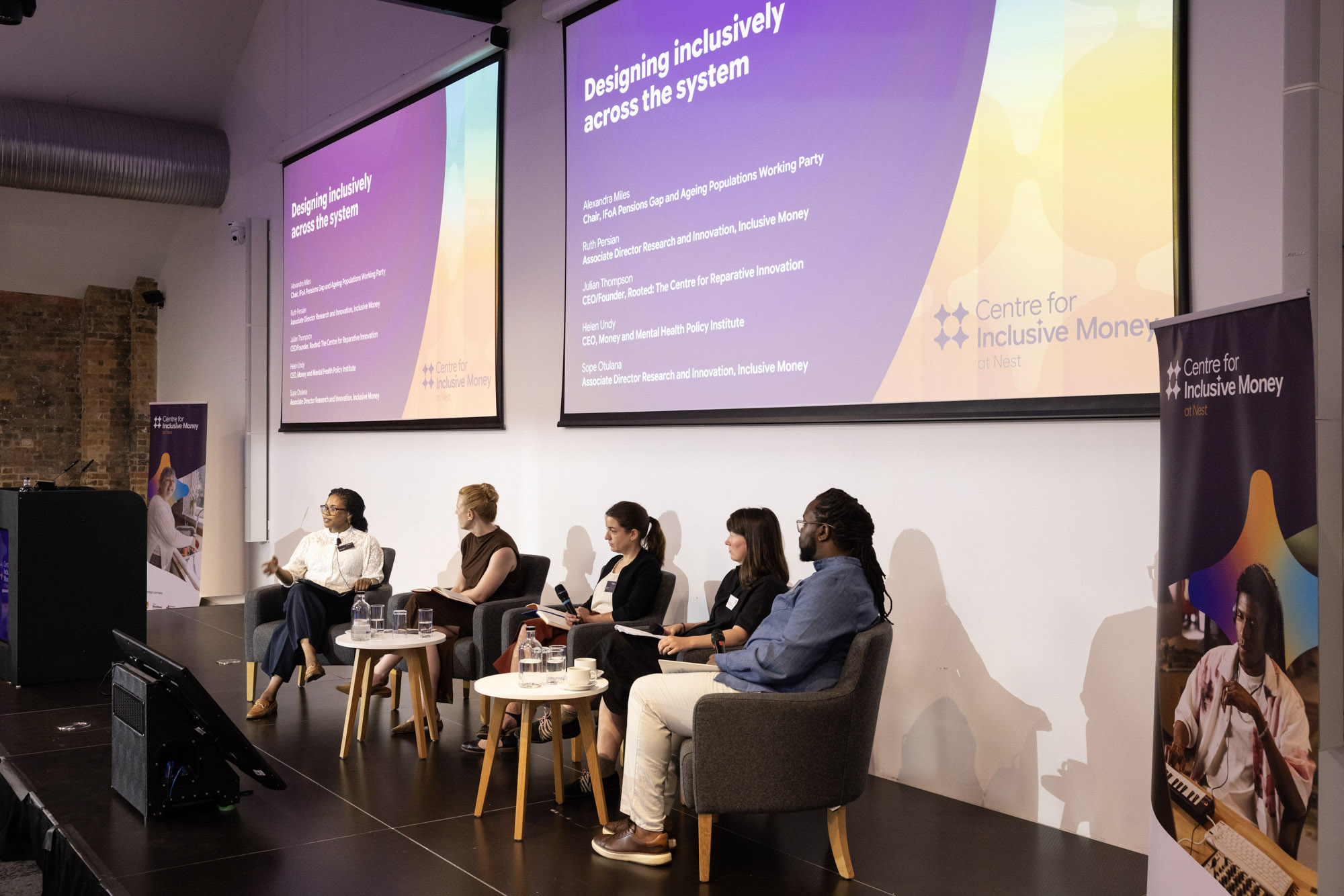
The Centre for Inclusive Money held our annual conference at a moment when the case for a more joined-up system couldn’t be louder or clearer: one where the products, services and processes are designed around people’s real-life needs and contexts, rather than assumptions of what they need. A more cohesive system eases the mental load of managing their financial lives, can help relieve the tension between progressing in the present and planning for the future, and provides options that enable people to meet multiple needs at once. In our second panel of the day, we discussed inclusive design, and the real world examples of good practice, as well as the opportunities to bring people closer to the process and decisions that shape the system. The Financial Inclusion Strategy lays out a definition of inclusive design, “ensuring that diverse needs are put at the heart of product development.”
Our panel included Al Miles (Chair, IFoA Pensions Gap Working Party), Ruth Persian (Associate Director of Research and innovation, Centre for Inclusive Money), Julian Thompson (CEO, Rooted: The Centre for Reparative Innovation), and Helen Undy (CEO, Money and Mental Health Policy Institute).
Our panellists discussed what this really means in practice, and what difference it would make to people’s lives to have a system that they have helped shape, that makes sense within their lives and which goes beyond individual product offers.
We talked about the ways that most people’s lives don’t fit neatly into the assumptions that much of the system makes; they change employers, they manage living with mental health challenges, they have caring responsibilities, their housing situations change, and they have incomes that might dip and spike rather than staying steady and predictable.
Watch the panel discussion
A few insights from the discussion have stuck with me. My colleague Ruth helped us question what drives change within systems, and the opportunities for regulators and innovative providers to work together to create and scale solutions outside the “typical” mould, by sharing the example of the collaboration between the Centre for Inclusive Money and Monzo to address the UK’s self-employment retirement savings gap. As we consider how we’ll continue designing work to test joined-up borrowing and saving solutions, the framework that Helen described is also instructive. She outlined a set of questions from the perspective of someone using a product or service that are a helpful way to ask ourselves whether we’ve approached our design inclusively:
- Does it exist? (is there a solution that actually meets my needs, and isn’t so generic that it doesn’t work for me?)
- Can I have it? (i.e. are there barriers based on who I am or my circumstances)
- Can I use it without harm? (does this solution solve one problem but create others?)
We talked as well about how we create a shared standard that we’re working towards as a diverse set of actors across the system, with Julian reflecting on the need for more understanding of how exclusion happens in the first place, and Al describing how tangible progress helps people progress from being resilient to challenges today while building their ability to not only recover but also emerge without being further behind.
The session closed with a powerful call to action from Julian, who challenged us all to step up however we can, memorably reminding us that ‘design is always an act of power’ and that inclusive design is a leadership trait rather than an add-on to business as usual.
Do these messages resonate with you? We’d love to hear how you’re approaching inclusive design in your work, and examples of good practice you’ve seen or created: hello@inclusivemoney.org.uk
Sope Otulana – Associate Director, Research and Innovation