

There is broad agreement that pension contributions will need to rise if the UK is to avoid a future retirement adequacy crisis. Many people, including many lower earners, are not saving enough to reach the various living standard and retirement income benchmarks that we use to measure adequacy in later life.
But there is less agreement about the risks and trade-offs that higher contributions – particularly higher employee contributions – could create for lower earners. Understanding these trade-offs is central to our work at the Centre for Inclusive Money at Nest, which focuses on financial security for low- and moderate-income households both today and into retirement.
In the case of higher auto enrolment contributions, questions arise both when considering whether more people should be brought into automatic enrolment, particularly those earning below £10,000 a year, and whether contribution rates should increase for lower earners who are already eligible. We continue to see calls for a general move to 12% contributions, but also hear notes of caution about whether such an approach can be applied to those on lower incomes.1 How policymakers assess these trade-offs will shape decisions about where contribution increases should fall, how universal the system should become, and whether additional safeguards or flexibilities are needed to avoid unintended financial harm.
Auto enrolment rules offer some protection to low earners
The Pensions Commission’s first report examines these trade-offs in detail and rightly highlights concerns about pension adequacy among low earners. Around half (47%) of people earning less than £13,500 are projected to fall short of Pensions UK’s minimum Retirement Living Standard – a benchmark for the income needed to reach a minimally acceptable standard of living in retirement.2
That is concerning. Low income during working life should not automatically condemn someone to poverty in retirement. But there are valid questions about how far higher individual pension contributions are the right thing to do when low and often unstable earnings can make it difficult for people to contribute regularly without causing additional financial strain.
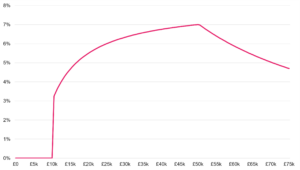
Today’s auto enrolment system provides some protection against defaulting low earners into pension saving where it may be unaffordable. An earnings trigger means that only employees earning more than £10,000 per year in a single job are automatically enrolled by their employer. The Lower Earnings Limit (LEL) of a Qualifying Earnings Band means contributions are usually calculated only on earnings above £6,240. In practice, this keeps pension contributions lower as a share of total pay for many lower-paid workers, as shown in Figure 1.
Figure 1: Pension contributions make up a smaller proportion of pay for lower earners as a result of the Lower Earnings Limit
Pension contributions as a percentage of total pay under current auto enrolment rules, by earnings
Source: Centre for Inclusive Money.
Those protections were established for a good reason: pension saving is not always affordable for people on the lowest incomes. But they also create challenges elsewhere in the system.
The clearest problem with the £10,000 earnings trigger is participation. In 2024, only 37% of employees earning less than £10,000 were saving into a workplace pension, compared with 78% of those earning between £10,000 and £20,000.3 And because women, carers and disabled people are more likely to be low earners, the trigger risks entrenching unequal pension outcomes for these groups.
The trigger also works badly for people holding more than one job. Someone may earn more than £10,000 overall but fall below the threshold in each individual job, meaning they miss out on being automatically enrolled. In March 2024, there were over 1.3 million people with multiple jobs, and while the majority are saving, there are potentially hundreds of thousands missing out.4
The challenges with the LEL are about both fairness and adequacy. Fairness, because just as the LEL reduces employee contributions as a share of total pay, it also reduces employer contributions – something we will return to in a future blog. As a result, lower earners often receive less generous employer pension contributions compared to higher earners.
And adequacy, because the LEL also dampens contributions as a share of total pay well beyond the lowest earnings levels. Contributions do not exceed 6% of total pay until earnings reach around £25,000, meaning the LEL continues to weigh on adequacy even where affordability pressures are likely to be less acute.
Given these problems, scaling back these protections has some appeal. It would make the system more universal and increase contributions. But alongside a broader call for a higher headline contribution rate, the benefits from an adequacy and inclusion perspective need to be weighed against the affordability position for lower earners.
Some employees earning less than £10,000 could afford to save for retirement, but it could cause financial harm for many others
The Commission highlights evidence that low earners may have untapped capacity to save more. For example, the earnings trigger has been frozen at £10,000 since 2015, bringing more lower earners into pension saving. Auto enrolment now covers 86% of employees, up from 79% in 2012.5 This wider coverage has not been accompanied by a sharp rise in opt-out rates, suggesting that lower earners capacity to save may have been underestimated.
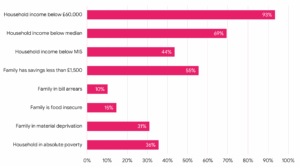
DWP analysis also suggests that many people earning less than £10,000 may be better placed to save than their individual earnings imply. For example, the analysis finds that 85% have characteristics suggesting they may be able to afford pension saving, with 55% living in an above-median income household and almost a quarter (23%) living in a household with income of £60,000 or more.6 On the face of it, this indicates that it might be reasonable to bring more people earning less than £10,000 within the remit of auto enrolment.
However, this analysis may give a false sense of security. The picture looks more challenging for those earning less than £10,000 depending on which data and income measure is used.
Our analysis finds that nearly half of (44%) private sector employees earning less than £10,000 live in households with incomes below the minimum Retirement Living Standard.7 In other words, many working-age adults already cannot afford the spending considered necessary for a minimum standard of living in retirement, even though retirees are typically assumed to have lower essential costs. Many lower earners also rely heavily on their own earnings: 35% of employees earning less than £10,000 are the sole earner in their household.8 For these people, the trade-off of reduced consumption today to fund increased consumption in retirement may simply not be feasible. This analysis differs from that in the Commission’s first report because it uses a different dataset and uses an after-housing costs measure of income. One isn’t necessarily more valid than the other, but the differences demonstrate that the extent to which higher household earnings offset concerns about low individual earnings and affordability is open to some interpretation and judgement.
The picture becomes even starker when we look at financial hardship. More than three in ten (31%) private sector employees earning less than £10,000 live in a family experiencing material deprivation, and 15% are food insecure. For people facing that level of pressure, pension saving is unlikely to be affordable or appropriate.
Figure 2: More than a third of employees earning less than £10,000 were living in poverty
Proportion of private sector employees aged 22 to 66 earning less than £10,000 that have characteristics that suggest pension saving may be unaffordable: UK, 2024-25
Notes: Income is net equivalised income after housing costs. Equivalisation uses the OECD modified scale. Single/couple households with children have their income equivalised to the level of a single/couple household without children before being compared with the Pensions UK minimum retirement living standard from 2024. Absolute poverty is people living in households with income below 60% of median income in 2024-25.
Source: Centre for Inclusive Money analysis of Department for Work and Pensions, Households Below Average Income 2024-25.
Higher contributions for those already eligible for auto enrolment may also be unaffordable
What about low earners who are already eligible for auto enrolment – what would be the impact of defaulting them to contribute more? Firstly, the retirement income adequacy case is not as straightforward as it appears. Against Target Replacement Rates (TRRs), only one in eight (13%) people with pre-retirement earnings below £15,900 were projected to be undersaving in 2025, rising to 26% among those earning between £15,900 and £29,000.9 For many low earners, the State Pension already replaces a high proportion of their working-age income. As a result, the State Pension combined with small levels of private pension saving could therefore push some people into saving more today for a retirement income that may exceed their current standard of living. That may sound positive, but it is hard to justify if it results in increased financial hardship today.
Evidence points to affordability constraints at current contribution rates. Even among employees already eligible for automatic enrolment, participation is lower among those on lower incomes. In 2025, 78% of employees earning £10,000 to £19,999 were participating in workplace pension saving, compared with 89% of those earning £20,000 to £29,999.10 While a range of factors is likely to explain this gap, affordability is almost certainly one of them. Recent research found that 46% of working-age people said they could not afford to put money away for retirement at the moment. Among low earners, that figure rose to 71%.11
The data also suggests that many low earners are already navigating difficult financial trade-offs at current contribution rates. Among private sector employees earning £10,000 to £19,999 who are already contributing to a pension, more than one in five (22%) were in material deprivation in 2024-25, and one in ten were food insecure.
Increased contributions for people affected by these issues could therefore create significant challenges and risks of harm. As the Commission’s report highlights, these trade-offs are offset to some degree by the design of Universal Credit (UC), which can create a strong incentive for many low earners to save into their pension. Under UC, each £1 of pension contributions reduces the earnings used to calculate their award by £1. With a 55% taper, a £100 pension contribution can therefore increase Universal Credit entitlement by £55, significantly offsetting the impact of higher contributions on take-home pay.12 However, among the 6.4 million employees aged 22 to 66 earning less than the full-time National Living Wage, only 1.4 million receive Universal Credit.13 Therefore, the UC offset would only help a minority of lower-income workers.
Figure 3: Some lower earners participating in pension saving show signs of financial stress
Proportion of private sector employees earning £10,000 to £19,999 with an employer pension in material deprivation, food insecurity and bill arrears: UK, 2019-20 to 2024-25
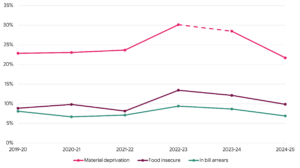
Notes: Employees are aged 22 to State Pension age to align with auto enrolment eligibility. A revision in material deprivation methodology from 2023-24 create a break in the series meaning that data from 2023-24 is not comparable to data before 2023-24.
Source: Centre for Inclusive Money analysis of Department for Work and Pensions, Households Below Average Income.
As we describe above, the right to opt out has also been seen as an important safeguard for those for whom pension saving might not be appropriate and the persistent low levels of opt-out and cessation have been seen as evidence that lower earners have a greater capacity to save than initially assumed, particularly in the context of the earnings trigger being frozen since 2014-15. However, Figure 3 shows that some low earners continue to contribute despite acute short-term financial pressures. This is consistent with evidence we’ve seen from our wider research programme. For example, opt-out rates remained remarkably low throughout the Covid pandemic and the subsequent cost of living crisis – both external shocks that might have been expected to prompt some increase in opt-outs and cessations.14 We also see evidence of increases in borrowing or reductions in precautionary savings when people are enrolled into pension saving – neither of which are necessarily net positive outcomes for financial security.15
Coupled with wider evidence on low engagement with pension saving, and our broader work on the complexities of household financial management for those on low and volatile incomes, this evidence suggests low opt-out rates could be read as simply low levels of engagement and very strong inertia, rather than an absence of harm or complex trade-offs. This alternative interpretation of the opt out data needs to be accounted for when considering future increases in contributions. At the same time, there may be a tipping point beyond which pension saving is no longer perceived as affordable, leading to a sharp rise in opt-out rates that could undermine the intended benefits of higher contributions. That would also be a concern given the binary nature of the contingent employer contribution, meaning that people who decide they cannot afford the default contribution rate also forgo the employer contribution.
The trade-offs faced by lower earners points to a need for greater flexibility within auto enrolment
Low earners are not a homogenous group. Some have the potential to save more for retirement – for example, those in higher-income households – and should be supported to do so. As we said at the outset, the aspiration should be for as many people as possible to be building meaningful private pension wealth to supplement their State Pension entitlement, including lower earners. But many in this group are already experiencing low living standards today and potentially face significant risks and complex trade-offs from higher contributions.
Reaching a consensus on whether the lower earners ‘problem’ is really a problem – and, if so, which groups are most affected and how far any risks should be mitigated – will be critical for the Commission. Protecting one of auto enrolment’s greatest strengths – its simplicity – is an important prize. But the greater the perceived risks and trade-offs for lower earners, the stronger the case for some flexibility, even if that adds more complexity.
Our work on Pension-Adjacent Emergency Savings Accounts (PAESAs) offers one pragmatic route to achieving this.16 By bringing short- and long-term saving needs into one framework, with a targeted emergency savings element built into the employee contribution for some workers, PAESAs could help manage the trade-offs between broader coverage, higher retirement saving and greater financial security. Other flexible, targeted approaches, such as non-contingent employer contributions or auto escalation in contribution rates, could also raise pension saving while keeping the system accessible and beneficial for lower earners.
Overall, our concern is that the data suggests there is a problem that needs to be addressed if auto enrolment coverage and contribution levels are to expand successfully, with the right balance of inclusion, adequacy and affordability. However, there is clearly a spectrum of views, and we look forward to continuing to engage on this issue as the Commission’s important work develops.
Molly Broome
To find out more about our work on workplace emergency savings, visit: https://www.inclusivemoney.org.uk/research-projects/workplace-emergency-savings
1 Pensions Policy Institute (July 2026), Pensions Adequacy: Housing, Households and Auto-Enrolment; Pensions UK (June 2026), Closing the gaps: Can flexible contributions make retirement savings more affordable?; Institute for Fiscal Studies (July 2026), Are people saving enough for retirement?.
2 Department for Work and Pensions (July 2025), Analysis of Future Pension Incomes 2025.
3 The Second Pensions Commission (May 2026), Pensions 2050: Evidence and Future Priorities and Department for Work and Pensions (July 2026), Workplace pension participation and savings trends of employees.
4 The Second Pensions Commission (May 2026), Pensions 2050: Evidence and Future Priorities.
5 The Second Pensions Commission (May 2026), Pensions 2050: Evidence and Future Priorities.
6 The Second Pensions Commission (May 2026), Pensions 2050: Evidence and Future Priorities.
7 The minimum Retirement Living Standard is £13,900 for a single pensioner and £22,500 for pensioner couples. For more information see: Pension UK, Retirement Living Standards.
8 The Centre for Inclusive Money analysis of Department for Work and Pensions, Family Resources Survey 2024-25.
9 Department for Work and Pensions (July 2025), Analysis of Future Pension Incomes 2025.
10 Department for Work and Pensions (July 2026), Workplace pension participation and savings trends of employees.
11 The Second Pensions Commission (May 2026), Pensions 2050: Evidence and Future Priorities.
12 The Second Pensions Commission (May 2026), Pensions 2050: Evidence and Future Priorities.
13 Centre for Inclusive Money analysis of Department for Work and Pensions, Family Resources Survey 2024-25.
14 The Centre for Inclusive Money (April 2024), How have workplace pension saving behaviours changed during high inflation?.
15 T Choukhmane & C Palmer (October 2024), How do consumers finance increased retirement savings?
16 The Centre for Inclusive Money (June 2026), Balancing today and tomorrow.